
A note: Dan Reyes and his restaurant are fictional. This is an illustrative scenario built from patterns we see regularly in real Spokane and Tri-Cities area kitchens. Not a profile of a real customer.
Dan Reyes had been running his 45-seat neighborhood spot for three years when his accountant said something that stopped him cold.
“Your revenue is growing,” she told him, sliding a printout across the table. “Your profit isn’t.”
He’d heard variations of this before and had always chalked it up to the cost of growing: more staff, more product, more everything. But this time he looked harder at the numbers. And what he found wasn’t in the revenue column or the labor column. It was hiding in the places he’d stopped looking: food waste, utility bills, overtime during close, and the slow bleed of a kitchen that was working harder than it needed to.
What followed was twelve months of deliberate, unglamorous investment. Not a renovation. Not new branding. Just a clear-eyed look at which pieces of equipment were costing him money every single day and what it would take to stop the bleeding.
Here’s what he found.
Investment 1: A Proper Walk-In Refrigeration Upgrade
Dan’s walk-in was original to the space: eight years old, never fully serviced, and quietly losing the battle against a Spokane summer. He knew the coils were dirty. He knew the door seal on the left side was soft. He’d been meaning to deal with it for two years.
What he hadn’t done was calculate what it was costing him.
When he finally pulled his produce waste numbers and cross-referenced them against his delivery schedule, the pattern was clear. A product that should have lasted four days was lasting two and a half. Herbs were wilting. Proteins were cycling through faster than they should. He’d been blaming his prep team. He should have been blaming his refrigeration.
A full walk-in service including new door gaskets, coil cleaning, thermostat calibration, and a compressor inspection was a fraction of what the neglect had been costing him. Within thirty days his produce waste had dropped measurably. Within ninety days he’d documented enough savings in wasted product alone to cover the service cost several times over. The energy savings from a properly running compressor were a bonus he hadn’t even factored in.
He thought he couldn’t afford to fix it. Turns out he couldn’t afford not to.
Investment 2: A Commercial Slicer Worth Using

Dan’s prep team had been using a slicer he’d picked up secondhand from a restaurant that had closed. It worked, in the sense that it sliced things. But the blade was dull, the thickness adjustment was unreliable, and his cooks had developed an unconscious workaround: cutting protein portions slightly thicker than spec to compensate for the inconsistency.
He didn’t notice it until a line cook mentioned it offhandedly during a staff meeting. “We go a little heavy on the slicer stuff because you never know what you’re going to get.”
He went back and looked at his portion cost data. On proteins alone, the informal over-portioning had been adding a few ounces per serving across dozens of covers a day. Multiplied across a year of service, the number was significant enough to make him wince.
A quality commercial slicer with a consistently sharp blade, reliable thickness calibration, and the kind of build that holds its settings under daily use paid for itself inside six months. His prep team also moved faster with less effort, which had a downstream effect on how they felt at the end of a long prep shift. That part didn’t show up in the spreadsheet, but Dan noticed it.
Investment 3: Walk-In Shelving That Actually Worked
This was the investment Dan had resisted longest, because the fix was so simple.
His walk-in shelving had been rearranged so many times over three years that it had become a kind of archaeological record of every operational decision he’d ever made and then changed. Shelves at the wrong heights. Product stacked directly against walls with no airflow. No consistent labeling system. His opening crew spent time every morning figuring out what they had before they could figure out what they needed to order.
He invested in a proper wire shelving system with adjustable heights, good airflow around produce, and enough organization to support a real FIFO rotation. He also had his team implement a labeling standard and stuck to it.
The immediate effect was a reduction in ordering errors. When you can see what you have, you don’t overbuy. When a product is rotating properly, you don’t find half a case of something in the back of the walk-in that expired while you were ordering more of it. Dan estimated his over-ordering dropped in the first month, not because he started ordering less, but because he stopped ordering things he already had.
The shelving investment was modest. The savings in over-ordering and spoilage were evident within weeks.
Investment 4: A Dishwasher That Closed on Time
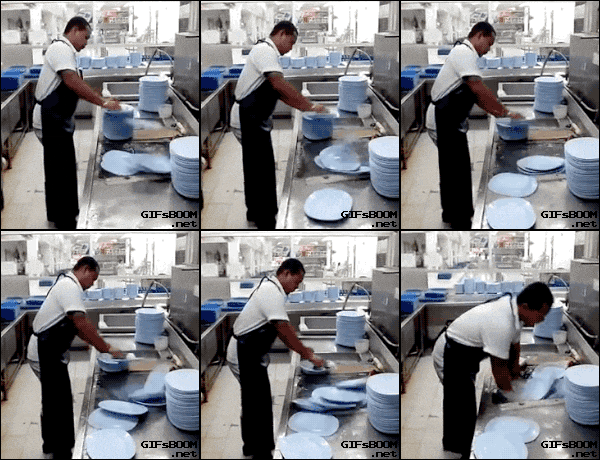
Dan’s dishwasher wasn’t broken. It was just slow. And loud. And required a full cycle restart about twice a night when the sensors got finicky. His closing crew had built an extra forty-five minutes into their mental close time just to account for it.
He’d never thought of this as a money problem. It was an annoyance problem. But when his general manager pointed out that two closing staff members were consistently clocking out well past when they should have been, three to four nights a week, every week, the math changed quickly. Overtime at the end of a close shift adds up faster than most operators realize, especially when it’s invisible inside normal payroll variation.
He replaced the unit with a reliable door-type dishwasher that cycled consistently, cleaned thoroughly, and required exactly zero coddling from his closing team. Close times tightened immediately. Within three months the labor savings had covered a significant portion of the new machine’s cost. His closing crew, for the first time in two years, stopped dreading the end of service.
Investment 5: Energy-Efficient Cooking Equipment on the Line
This was the investment Dan had resisted longest, because it required replacing equipment that technically still worked. His range and his commercial fryer were both original to his opening: older units that ran hot, ran loud, and ran constantly, even during slow periods when he didn’t need them at full capacity.
His utility bills had always felt high, but utility costs are easy to normalize when you’re busy. It took an equipment supplier walking him through the energy consumption difference between his current range and a modern energy-efficient unit before the number landed properly. His older equipment was drawing significantly more power per hour than a newer equivalent, and he was running it twelve hours a day, six days a week.
He replaced the fryer first since it was the higher energy draw and the older of the two units. The new fryer also had better temperature recovery, which meant less oil degradation, longer oil life, and more consistent fry results during peak service. His oil costs dropped. His utility bill dropped. His fry quality improved. Three separate wins from one piece of equipment.
The range followed six months later. Between the two replacements, his monthly utility bill came down by enough to notice, and the consistency of cooking on a properly calibrated modern range had effects that rippled through food quality in ways that are harder to quantify but impossible to miss.
What Dan Learned (That Most Operators Learn Too Late)
By the end of the year, the documented savings across all five upgrades, reduced food waste, better portion consistency, lower over-ordering, labor savings at close, and lower utility costs added up to significantly more than the investment. That doesn’t count the harder-to-measure improvements: better food quality, a prep team that moved faster with less frustration, a closing crew that didn’t dread the end of service.
“The thing I keep coming back to,” he told a friend who was opening his first restaurant, “is that none of it was dramatic. It wasn’t a renovation. It wasn’t a new concept. It was just fixing the things that were quietly draining money every single day, and I’d been walking past all of them for three years.”
The best equipment investments aren’t always the flashiest ones. Sometimes they’re the refrigerators that hold temperature properly. The slicer that cuts consistently. The dishwasher that closes on time. The shelving system that lets your team see what they actually have.
The money was always there. It was just going to the wrong place.
Find Your Hidden Savings.
At Spokane Restaurant Equipment, we help operators find the equipment upgrades that actually move the needle, not the flashiest purchases, but the ones that pay for themselves. Stop by our showroom or give us a call. Sometimes all it takes is a conversation to find where the money is going.